Achintya.

Project 01 · Lead Designer

Smart Chair

A user-centred redesign of the standard Indian classroom chair, integrating storage and ergonomic back support — developed through surveys, CAD modelling, and a laser-cut prototype, and written up as a research paper.

01Problem statement

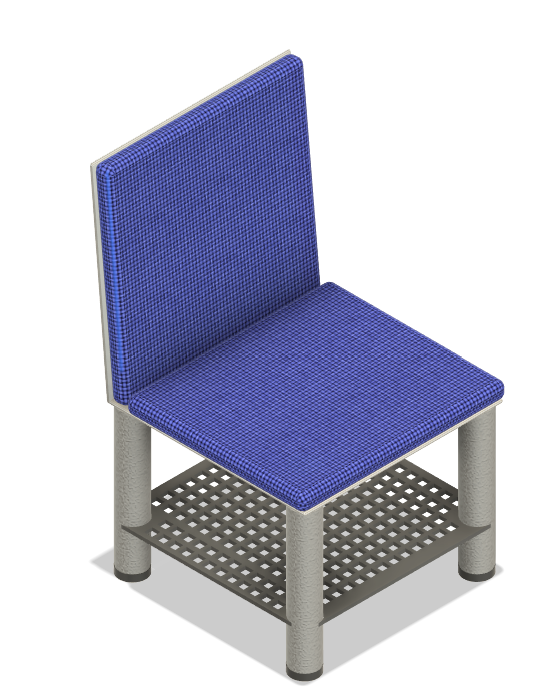
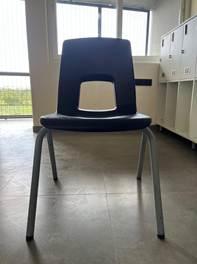
The standard classroom chair in many Indian schools is a one-piece injection-moulded polypropylene shell riveted to a powder-coated steel tube frame. It is cheap, light and stackable, but it was designed for low-cost bulk procurement rather than for long periods of sitting: no padding or lumbar contour, no provision for a school bag, and no storage. Bags are left on the floor, where they clutter aisles and create trip hazards, and books must be carried between lessons.
02The existing product, measured

The existing chair was documented by photograph, hand sketch and CAD model, and analysed for function, ergonomics, materials, cost, process energy and end-of-life impact. A cost breakdown estimated its manufacturing cost at about ₹765 per unit, of which roughly ₹195 is the 2.6 kg steel frame (3 m of Ø25 mm × 1.5 mm tube), with 3.35–4.75 kWh of process energy per chair. Because the plastic shell is riveted to the steel frame, the two materials are difficult to separate at end of life, which reduces recyclability.

03Background and motivation

Students spend most of the school day seated, and the chair is one of the main factors shaping sitting posture. Observing classmates and teachers — bags on the floor, books carried between every lesson, constant shifting for comfort — raised the question of why such a widely used product addresses so few of its users' needs.

04What published research says

Studies in several countries report a persistent mismatch between classroom furniture and students' body dimensions. In Abha, Saudi Arabia, seat-height mismatch reached 75.6–84.3% and seat-depth mismatch 74.0–84.5% among 879 adolescents. A study of 432 Portuguese primary pupils found a significant mismatch between the furniture supplied and the children's anthropometry, and work in West Bengal with 703 girls aged 10–15 found high mismatch in seat height and width across Classes V–X. A review of ten studies published between 2004 and 2017 concluded that ill-fitting furniture contributes to poor posture and musculoskeletal complaints in pupils.

05The bag-load problem

A critical review of 21 studies found that about 10% of body weight is the most commonly cited maximum school-bag load, yet students carried more than 15% on average, with measurable postural change and associated back pain. Where the bag goes during the school day is part of the seating problem, not a separate one.

06Research gap

Most prior work evaluates either furniture fit (seat height, depth, desk height) or bag load in isolation. Few studies address the everyday organisation problem — where the bag, books and stationery go during the school day — together with posture, and fewer still do so for the low-cost moulded chairs common in Indian classrooms, within the weight and cost limits of institutional purchase.

07Research question and objectives

Can a standard school chair be redesigned to integrate bag, book and stationery storage and improve back support, while staying under 10 kg, supporting a 120 kg load and remaining cost-effective for bulk purchase? The objectives were to (i) identify user problems through product analysis and a survey; (ii) translate them into a measurable specification; (iii) generate and evaluate design concepts; (iv) select a shell material; and (v) build and test a scale prototype.

08User survey — the problems

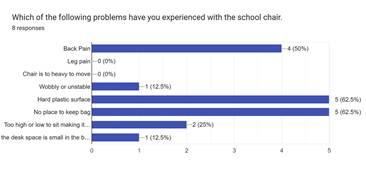
An online questionnaire completed by eight students identified the main problems with the existing chair: a hard plastic surface (62.5%), nowhere to keep a bag (62.5%), and back pain (50%), followed by a seat too high or low for the desk (25%) and instability (12.5%).

09User survey — the most-wanted features

Asked for the single most-wanted feature, respondents chose better back support (37.5%), a bag holder (25%), a softer seat (25%) and a book-and-stationery holder (12.5%). All respondents preferred keeping their bag beside them over storing it in a locker or cubby, and no respondent found the chair too heavy.

10The armrest poll — and dropping foldability

A follow-up poll of 48 students, supported by informal interviews, found 89.6% did not want armrests. Half the survey respondents saw no need to fold or move the chair outdoors because outdoor seating had already been installed for project-based learning. Foldability and armrests — both initial assumptions — were therefore dropped from the requirements. The survey showed students' complaints concerned comfort and organisation, not mobility.

11Market analysis

Six commercial alternatives priced between ₹390 and ₹11,126 per chair — including models from SOMRAJ, Nilkamal, Flash Furniture, Swagath, CELLBELL and Virco — were compared on features, advantages and disadvantages. Improvement opportunities were listed under seven headings: ergonomics, handling, sustainability, stackability, aesthetics, safety and functionality. The market is saturated with largely undifferentiated products, and the high cost of custom design for bulk institutional purchases forces schools to accept suboptimal options.

12Standards and anthropometry

Secondary data came from the Indian school-furniture standard IS 4837, the educational-seating standards EN 1729 and ANSI/BIFMA X6.1, and anthropometric tables for the target age group. These set the dimensional envelope: a 430 mm seat height from popliteal height, a 400 mm seat depth from buttock–popliteal length, a 400–450 mm seat width from hip breadth, and a 300 mm backrest from sitting shoulder height.

13Design specification

Survey findings, anthropometric percentiles and standards were combined into a measurable specification. The 10 kg mass limit was derived from a safe-lift estimate of about 22% of body mass for a 55 kg upper-secondary student (12.1 kg), reduced to give a margin. A 120 kg design load was adopted as a conservative target that also covers adult visitors.

14Concept generation

Seven concepts were developed from rough sketches into Fusion 360 models with isometric, orthographic and exploded views, each with a parts list giving material, reason for choice and manufacturing method. Supporting comparisons were made of base type (four-legged, three-legged, cantilever, swivel and solid) and of eight floor-glide options scored on floor protection, slip resistance, durability, replaceability, cost and ease of installation.

15Concept evaluation

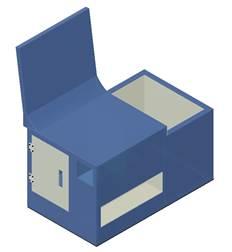
Each concept was scored from 0 to 10 on ten criteria — ergonomics, stability/safety, storage, material suitability, manufacturability, durability, maintainability, aesthetics, sustainability and cost-effectiveness — against a four-level rubric, giving a total out of 100. The highest-scoring concept (82/100) combined a box-frame body with an enclosed book-and-stationery locker, a side bag bay, a bottle slot and a recessed footrest.

16Material selection

Eleven candidate materials were scored from 1 to 5 on ten criteria in a weighted decision matrix. Weights were long-term durability 20%; strength and impact resistance 15% each; cost, corrosion resistance and ease of cleaning 10% each; and weight, workability, aesthetics and sustainability 5% each. High-density polyethylene (HDPE) won with 4.95/5.

17The final design

The redesign treats the chair as a personal workstation: the bag is kept off the floor and within reach, and books for the next few lessons can be stored without taking up desk space. The enclosed claddings also brace the frame, which helps the chair carry the 120 kg design load at under 10 kg. The 98° seat-to-backrest angle is a compromise between the upright posture needed for writing and the reclined postures that spinal MRI research associates with lower disc strain.

18Prototype fabrication

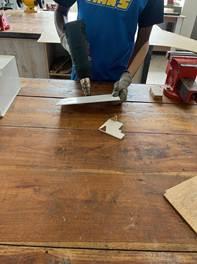
The final design pairs an aluminium sub-frame (3.78 kg) with an HDPE seat and back shell (1.14 kg), giving an estimated full-scale mass of 9.9 kg — inside the 10 kg carry target. A 1:3 scale prototype was produced in laser-cut acrylic, with the seat-and-backrest heat-bent to 98°.

19Testing against the specification

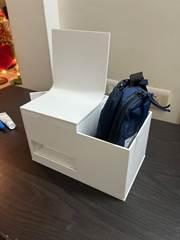
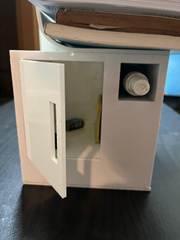
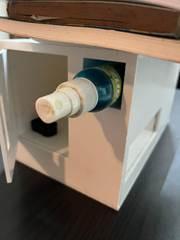
The scale prototype was evaluated against the specification and tested with students and teachers. It confirmed the geometry, the assembly sequence and the storage function — the locker, bag bay and bottle slot all work as intended. It also revealed limits: flat-sheet construction cannot show the seat curvature that injection-moulded HDPE would allow, the acrylic surface scratched during handling, and the door screws remain exposed, which does not yet meet the safety specification.

20Constraints and trade-offs

Cushioning was rejected because it wears and is hard to keep clean in shared classrooms, so comfort depends entirely on geometry — the 98° recline, the anthropometric dimensions and the footrest. The box base gives storage and stability but uses more material than a leg frame. And every added feature affects manufacturing cost — a decisive factor for schools buying furniture in bulk, where the target unit cost is below ₹1,500.

21Results and limitations

The primary survey had only eight participants from one school, so its percentages are indicative rather than representative. The prototype was built at 1:3 scale in acrylic, which differs in stiffness and brittleness from HDPE, so load capacity, tip resistance and comfort were not measured. The 430 mm seat height suits median users but is too high for the 5th percentile, and the recessed footrest only partly offsets this.

22Future work

Next steps: build a full-scale HDPE prototype and test it to EN 1729 and ANSI/BIFMA X6.1; measure the anthropometry of the target students and offer two seat heights; mould curvature into the seat and backrest; conceal the door fasteners; and run a multi-week classroom comfort trial with a larger, multi-school sample.

23Personal learning

The survey changed the design's direction twice: foldability was an initial assumption until the data showed nobody needed it, and armrests were dropped after 89.6% of 48 polled students said they did not want them. Designing from evidence rather than assumptions — and being willing to abandon a feature I had already drawn — was the project's biggest lesson.

24Connection to economics and applied mathematics

The existing chair costs about ₹765 to manufacture and dominates classrooms not because it serves users well, but because institutional buyers purchase in bulk and customisation is expensive. The redesign asks whether storage and ergonomics can be added within those constraints — a target below ₹1,500 per unit — which is a question about demand elasticity, procurement incentives and who bears the cost of better design. The weighted decision matrices and anthropometric percentile analysis are applied mathematics in service of that question.

Photographs & drawings

The existing classroom chair: one-piece polypropylene shell on a tubular steel frame.
Primary survey results (n = 8): problems experienced with the existing chair.
An early ideation concept modelled in CAD.
The final refined design: box-frame body with locker, bag bay and footrest.
Fabricating the 1:3 prototype — heat-bending the acrylic seat-and-backrest to 98°.
Functional testing: a school bag in the side bay.
Functional testing: the stationery locker with its door open.
Functional testing: a bottle in the bottle slot.