Achintya.

Project 02 · Designer & Builder

Smart Medicine Dispenser

SmartMed — an affordable medication management system with eight drawers, scheduled audio and visual reminders, and a companion phone app, designed around the needs of elderly users and caregivers.

01Problem statement

Managing daily medication schedules accurately is a major challenge for people who take multiple medicines each day. Users struggle to remember the correct timing, dosage and sequence of tablets — particularly elderly users, patients with chronic illnesses, and people with busy lifestyles. Missing medication or taking it at the wrong time can reduce the effectiveness of treatment and lead to serious health complications.
02Why this area matters

Research from the NHS indicates that many people miss doses because they forget, become distracted, or lack a reminder system that suits their lifestyle. A 2024 review of medication dispensing and reminder systems examined 426 studies and selected 56 for detailed analysis — the sheer volume of research shows how significant medication adherence is as a global healthcare issue. A 2024 study reports that around 50% of older adults struggle with medication adherence.

03The consequences of non-adherence

Medical: missed doses make treatments less effective and can worsen chronic conditions such as diabetes, heart disease and high blood pressure; in some cases incorrect medication use leads to emergencies or hospitalisation.

Economic: medication mistakes drive unnecessary healthcare costs through extra doctor visits, emergency treatment, hospital admissions and wasted medication.

Social: family members and caregivers often carry the monitoring burden, which creates stress, anxiety and caregiver burnout — particularly when supporting elderly patients with multiple prescriptions.

04The issue with existing solutions

Traditional pill boxes are passive: they organise medication but do not remind users, confirm whether a dose was taken, or prevent mistakes. Phone alarms and written notes can be ignored, forgotten or switched off. Advanced smart dispensers exist, but many are expensive, require subscriptions, internet connectivity or complex setup — discouraging exactly the elderly users who need them most.

05What the research literature says

A microcontroller-based reminder system tested with 110 patients found 84% said it reminded them effectively at the correct time — and its combination of RTC, OLED display, buzzer, vibration and phone calls showed that multiple reminder methods work better together than one alone. A descriptive study on pillboxes found 85% of older adults said the pillbox helped them manage medicines, showing organised storage itself has value.

A 2025/2026 study of 42,601 older-adult records found medication non-adherence of 5.9%, linked mainly to pharmacological factors and complex multi-medication regimens. And the REMIND randomised clinical trial, following 53,480 patients, found that low-cost reminder devices alone did not significantly improve adherence — an important warning that a simple alarm is not enough.

06User research plan

The project followed a structured plan: market analysis, secondary research, a survey, interviews, material analysis, specification, ideation, mechanism analysis, prototyping, manufacturing, testing, user feedback and evaluation against the specification.

07Survey findings — adherence

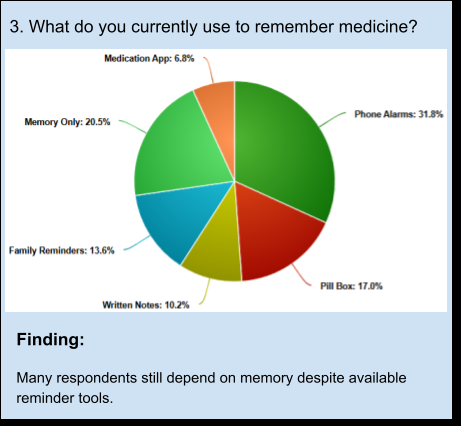
The survey showed that 48% of respondents take three or more medicines daily, increasing the likelihood of confusion and mistakes. 64% reported forgetting medication doses at least occasionally, and 36% still rely on memory alone despite available reminder tools. Remembering medication timing was the most common challenge.

08Survey findings — errors and identification

Nearly one-third of respondents had experienced medication errors, and 32% admitted to taking the wrong medicine or dosage at least once. 46% found it difficult to distinguish between different medicines — a problem when several tablets look similar.

09Survey findings — the features users want

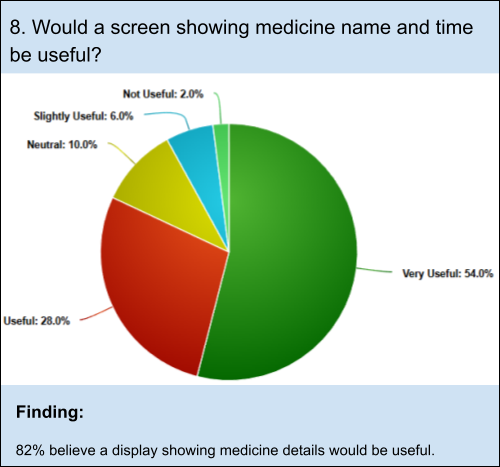
82% believed a screen displaying medicine names and timing would be useful. 80% considered audio reminders helpful. 78% stated that confirming a dose before taking it was important. 58% wanted caregiver notifications when doses are missed. These four findings became the core feature set: display, sound, confirmation and caregiver alerts.

10Interview evidence

Interviews reinforced the survey. Elderly participants reported forgetfulness and difficulty distinguishing similar-looking tablets; Lakshmi (72) said she would prefer a simple device with only essential functions and would likely need assistance during setup — so the product had to minimise complexity. Working adults highlighted the impact of busy schedules, and caregivers emphasised the importance of monitoring and tracking medication intake.

11Market analysis

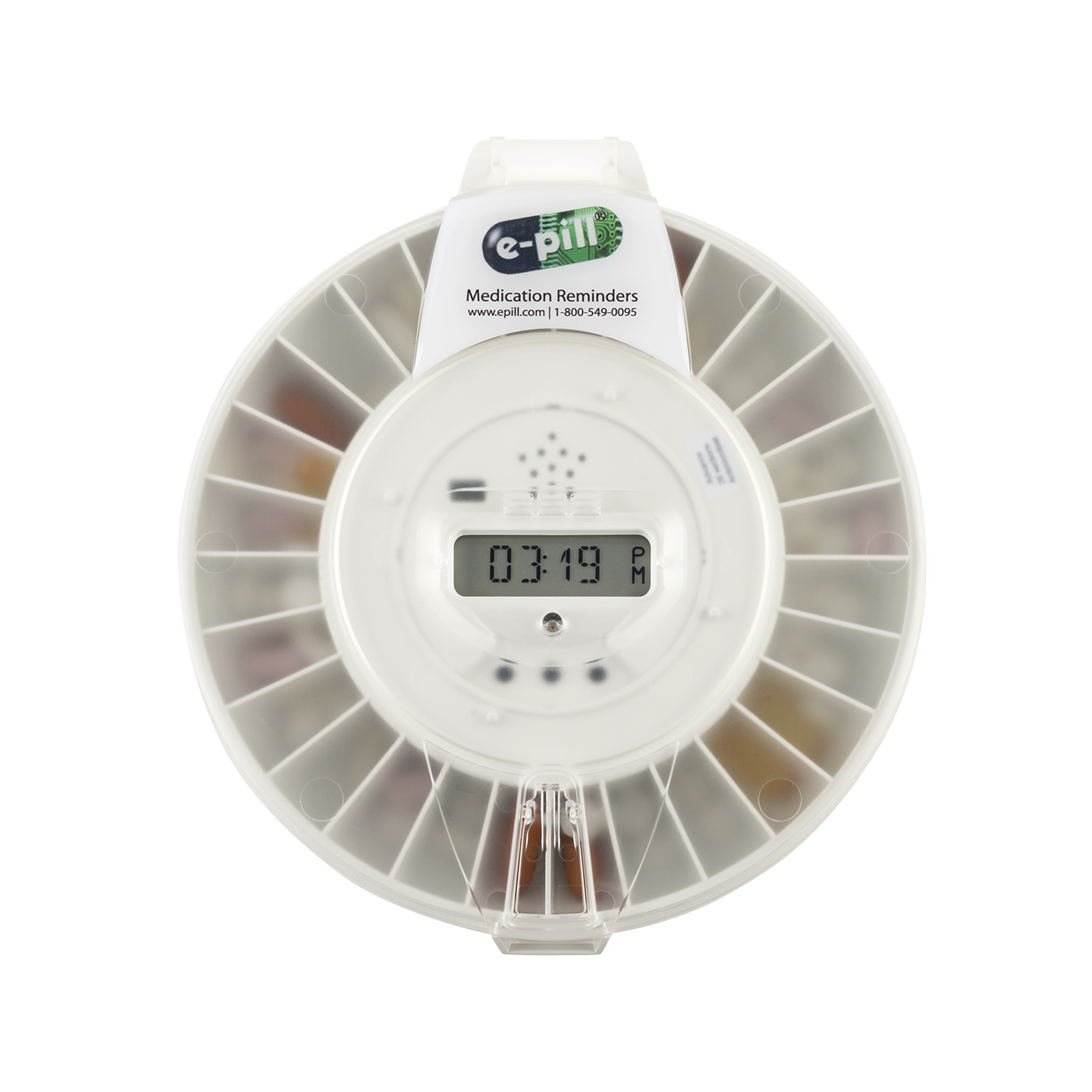
Commercial systems were compared, including the MedaCube, the Hero Smart Dispenser, and e-pill rotating dispensers. Their strengths — smart compartment sensors, LED indicators, warnings when the wrong compartment is opened, visual guidance to the correct compartment — informed the design, but their prices and subscription models put them out of reach for many households.

12Deciding the number of compartments

Research into medication routines showed that designing for only 4 compartments would exclude many potential users, while 10 or more would increase product size and complexity. Eight compartments provide the balance between user needs, product size and manufacturing complexity.

13Tablet capacity and weight

A capacity of 15 to 20 tablets per compartment meets the needs of most intended users while keeping the product compact and reducing refill frequency. Even with all eight compartments filled, the total weight of medication is approximately 80 g — less than a typical smartphone — so the stored medication contributes very little structural load.

14Material selection

Candidate housings were compared in a weighted decision matrix. PETG scored 89/100, ahead of ABS (80), PLA (76) and acrylic (68), balancing durability, surface finish, cost, workability and sustainability. The material also had to protect medication against moisture and contamination to maintain effectiveness and shelf life.

15Power system

The power supply must run the ESP32, OLED screen, speaker, LEDs and motor. A battery evaluation compared configurations, and dual 18650 lithium-ion cells in a parallel configuration were selected — reducing charging frequency and matching the approach used in portable consumer electronics, paired with a charging system consistent with modern devices.

16Standards and safety

The design was checked against international standards and regulations for consumer electronics, and a safety analysis covered electrical and mechanical safety — including the risks of a device that stores medication in a home environment, on bedside tables, within reach of children.

17Design process

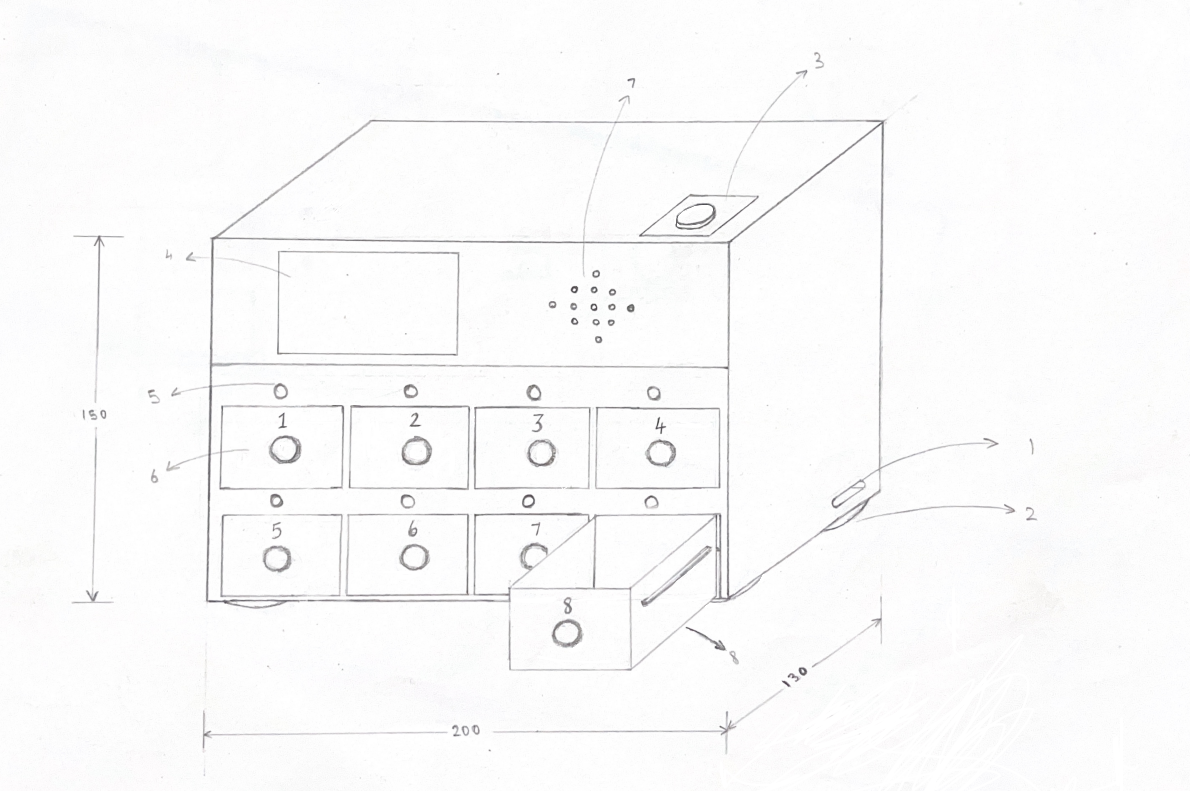
Ideation began from the survey and specification findings. The first concept sketched a compact desktop unit of 200 × 150 × 130 mm: eight numbered drawers in two rows, each with its own indicator LED, an OLED screen above, a speaker grille, and a single control button — the layout that carried through to the prototype.

18Technical implementation

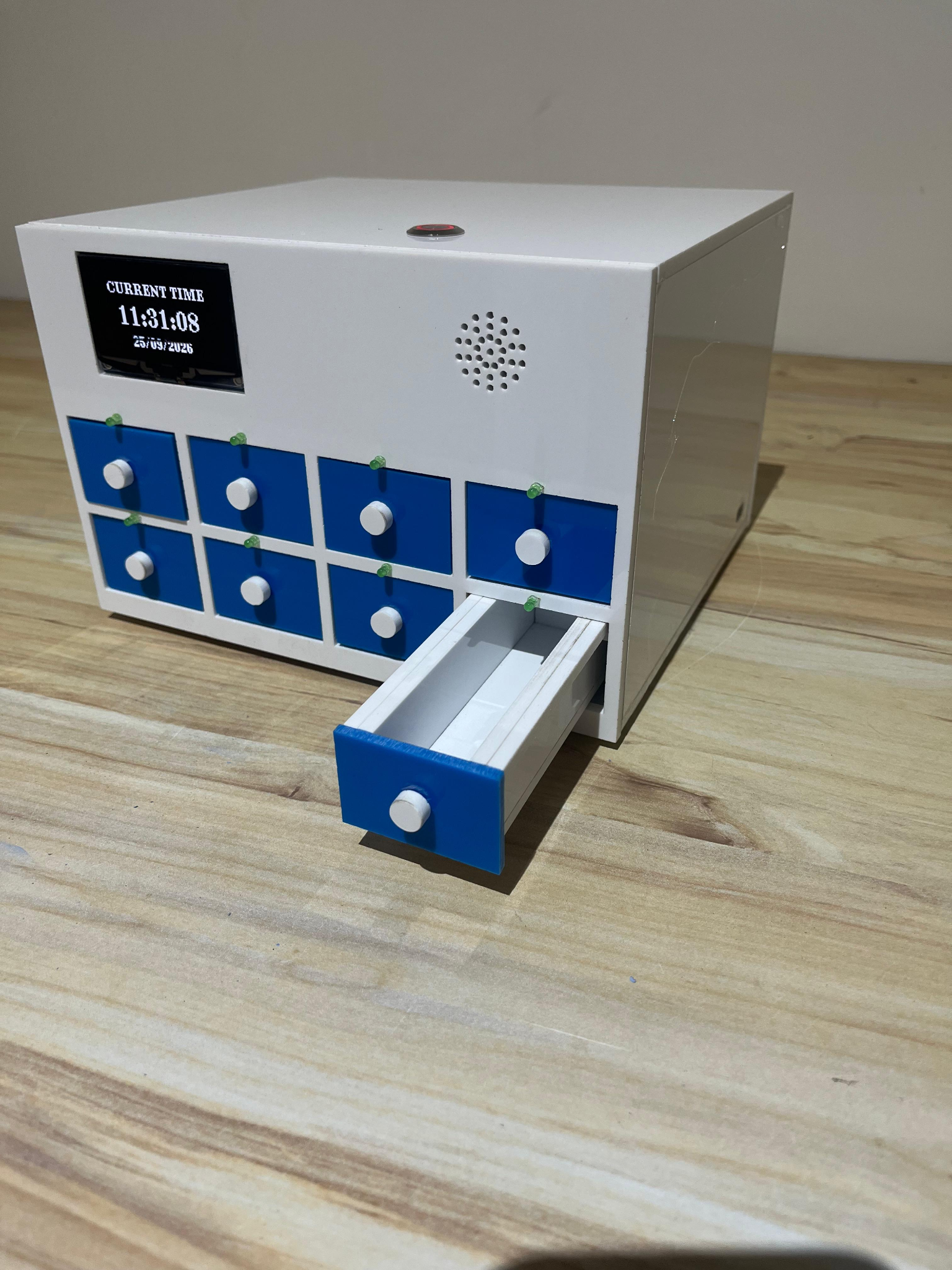
The prototype is built on an ESP32 microcontroller with a real-time clock, a 2.42-inch OLED screen that shows the medicine name and scheduled time before dispensing, audio reminders, and an LED indicator per drawer so the user opens the correct one. A Wi-Fi phone application built with Blynk handles scheduling and can notify caregivers when a dose is missed.

19Testing and iteration

Approximately 30 tests were carried out, including battery, restart and user testing.

Detailed test log and number of trial users to be confirmed.

20Constraints and trade-offs

Keeping within a ₹4,000–₹8,000 target cost meant balancing features against price — app connectivity, the OLED display and automated dispensing had to be delivered at a fraction of the cost of commercial systems like MedaCube. Simplicity was also a hard constraint: interview evidence showed elderly users wanted essential functions only.

21Results and limitations

The device remains a prototype and has not been medically validated. The REMIND trial's finding — that reminders alone do not significantly improve adherence — is taken seriously: the design therefore combines reminders with identification, confirmation and caregiver involvement rather than relying on an alarm alone.

22Personal learning

Detail to be added by Achintya.

23Connection to economics and applied mathematics

Medication non-adherence imposes real economic costs — extra doctor visits, emergency treatment, hospital admissions and wasted medicines — while the smart dispensers that could help are priced beyond many households or locked behind subscriptions. The project asks whether assistive health technology can be made affordable without losing the features that matter, which is as much an economic question as an engineering one.

Photographs & drawings

The working SmartMed prototype: eight drawers, OLED clock display, speaker and per-drawer LEDs.
Ideation sketch with overall dimensions (200 × 150 × 130 mm) and numbered drawers.
Survey: what people currently use to remember medication — 20.5% rely on memory alone.
Survey: 82% said a screen showing medicine name and time would be useful.
Market analysis: a commercial rotating dispenser (e-pill) — effective but costly.